


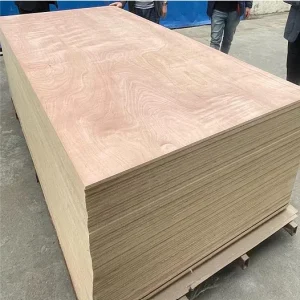
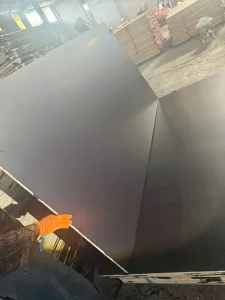
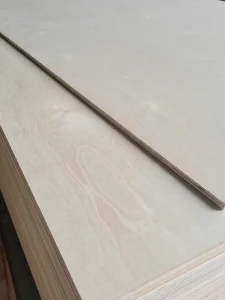
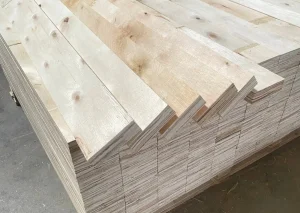
Film faced plywood is engineered specifically for the construction sector, serving primarily as concrete formwork and a high-load-bearing structural material. Unlike interior-grade plywood, the standard for film faced panels prioritizes bond integrity, moisture resistance, and surface durability over aesthetic visual uniformity.
The following outline describes the standardized manufacturing workflow for film faced plywood, excluding advanced core stitching or structural reinforcement procedures.
Process Overview
At Plywood ThanhdoLLC, the manufacturing sequence for film faced plywood is executed through a systematic, multi-stage workflow to ensure consistent performance. From the initial material selection to the final quality assurance phase, every step is critical in producing a high-performance construction panel.
1. Raw Material Selection and Veneer Preparation
The process begins by sourcing robust hardwood veneers, typically utilizing eucalyptus, acacia, or mixed hardwood cores. These species are chosen for their superior density, load-bearing capacity, and structural resilience. Veneers are selected based on technical specifications rather than visual appearance, optimizing production costs while maintaining construction-grade standards.
2. Manual Veneer Classification
Skilled workers manually sort and arrange veneers, purging any sheets with severe structural defects. This phase focuses entirely on mechanical strength; veneers are categorized into interior core layers or outer core layers based on their suitability for specific structural positioning, ensuring a consistent load-bearing profile across the finished panel.
3. Natural Air-Drying and Supplemental Conditioning
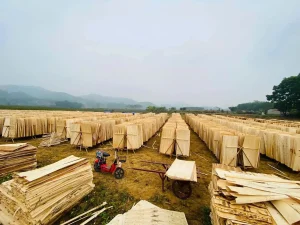
To preserve fiber integrity, veneers undergo natural air-drying. This method utilizes ambient airflow to gradually reduce moisture levels, which minimizes internal stress and enhances the wood’s natural adhesive-bonding properties. Supplemental drying chambers are only deployed during unfavorable weather to stabilize moisture content within the target 8–12% range.
4. Adhesive Application
Once the required moisture level is achieved, veneers are coated with phenol-formaldehyde (PF) resin. This adhesive is selected specifically for its thermal stability and water-boiling resistance, which are essential for formwork applications exposed to wet concrete.
5. Lay-up and Core Assembly
Veneer sheets are stacked in a cross-laminated orientation, where the grain direction of each layer alternates at 90-degree angles. This assembly method maximizes dimensional stability and ensures load is distributed uniformly across the entire board.
6. Cold Pre-Pressing
The assembled veneer stack undergoes a cold pre-press stage to stabilize the panel before heat is applied. This ensures the veneers are positioned correctly and the adhesive is distributed evenly across the bonding surfaces.
7. Hot Pressing
The panel is transferred to a high-temperature hot press, where heat and pressure facilitate the complete curing of the PF resin. This stage is the definitive moment of chemical bonding, establishing the panel’s structural integrity.
8. Rough Trimming and Preliminary Inspection
Following the hot press, panels are trimmed to oversized dimensions and undergo a visual check. Any boards exhibiting major structural anomalies are removed from the production line immediately.
9. Final Edge Trimming
Panels are processed through trimming saws to achieve standardized dimensions, square corners, and precise tolerances, ensuring they are ready for film application.
10. Film Adhesive Application
A layer of adhesive is applied to both faces of the plywood to prepare for the overlay process. The phenolic film is then positioned onto the board, providing the chemical and physical barrier required for high-frequency concrete pouring.
11. Film Curing (Film Press)
The board is returned to the press to ensure the phenolic film is permanently bonded to the core. A high-quality film press prevents surface bubbling, peeling, or delamination, significantly extending the service life of the formwork.
12. Final Dimensional Cutting and Edge Sealing
Panels are cut to final customer specifications. To prevent water ingress, all four edges are treated with a specialized waterproof sealant, a critical step for maintaining the panel’s lifespan on construction sites.
13. Final Classification and Quality Control
Finished panels undergo a rigorous inspection process focusing on:
-
Surface film adhesion strength.
-
Panel flatness.
-
Structural integrity. Only boards meeting construction-grade standards are approved for distribution.
14. Packaging and Warehousing
Approved panels are secured in moisture-resistant packaging. This ensures the edges and surfaces remain protected during international transit and long-term site storage.
For inquiries regarding our production standards or technical documentation for Plywood ThanhdoLLC products, please contact our export team.