



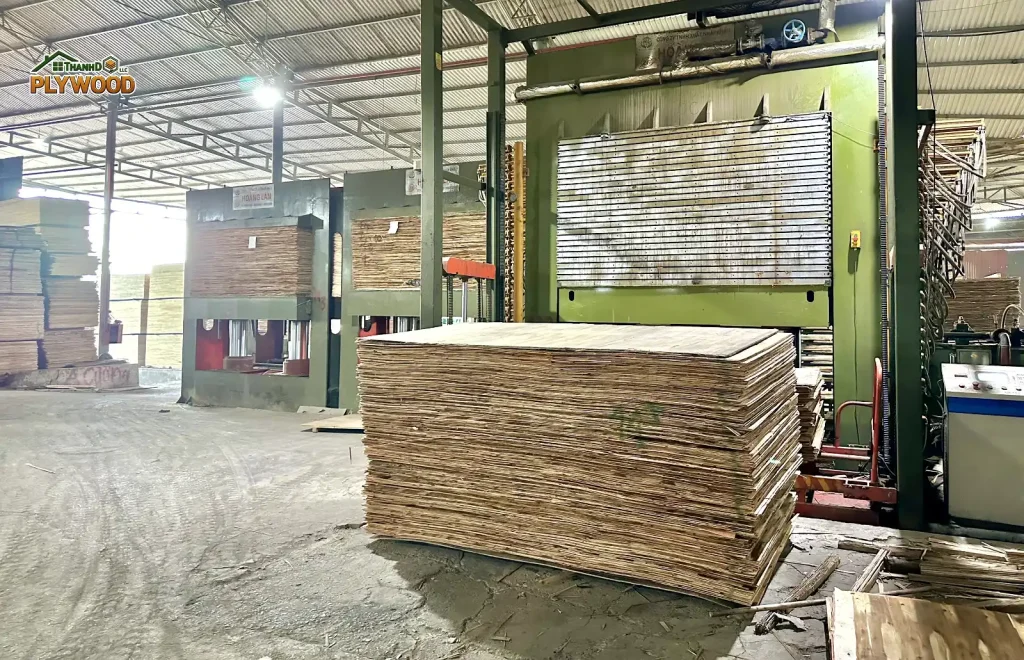
The transformation of raw logs into high-precision plywood is an intricate 10-stage journey. Every phase in this sequence is critical; quality added at one step can be nullified by errors in the next, and defects introduced early in production often become irreversible. While buyers typically assess panels based on surface appearance, price, and thickness, the underlying manufacturing discipline—spanning temperature control, glue formulation, and moisture management—dictates the product’s structural life, bond strength, and environmental compliance.
This guide provides an inside look at the manufacturing protocols utilized in Vietnamese facilities managed by Plywood ThanhdoLLC in Northern Vietnam. These parameters reflect real-world production data from factories capable of outputting 50–100 export containers per month.
Stage 1: Log Sorting and Species Selection
Production begins in the log yard, where the species and physical condition of the timber define the factory’s output potential.
-
Core Species: Vietnamese facilities primarily utilize three plantation-grown hardwoods:
-
Acacia (~580 kg/m³): The most accessible, cost-effective species.
-
Eucalyptus (650–750 kg/m³): The strongest, densest option, ideal for heavy-duty requirements.
-
Styrax (480–500 kg/m³): A lightweight, white-toned hardwood exclusive to Northern Vietnam, perfect for high-end furniture.
-
-
Grading: Logs are sorted by diameter (15–20cm minimum), straightness, and the presence of defects like rot or knots. Clean, freshly harvested logs are prioritized to ensure superior veneer quality.
Stage 2: Log Softening
To ensure smooth peeling, raw logs are softened via steam vats (60–80°C) or hot water soaking ponds (50–70°C) for 12–48 hours. This process reduces fiber rigidity, allowing the lathe to produce consistent sheets without tearing. Operators must carefully balance softening time; under-softening leads to surface checks, while over-softening creates dimensionally unstable, wavy veneer.
Stage 3: Rotary Veneer Peeling
Logs are rotated against a precision blade while a pressure bar compresses the wood ahead of the cut. The thickness of the resulting veneer depends on the lathe settings:
-
Face Veneer (0.2–0.4mm): Standard for high-appearance surfaces.
-
Core Veneer (1.2–2.0mm): The structural backbone of the panel.
Stage 4: Veneer Drying
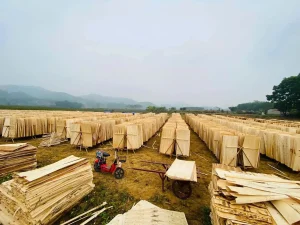
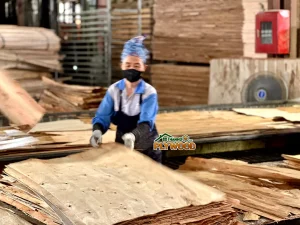
Fresh veneer contains 40–80% moisture, which must be reduced to 8–12% for core veneers and 6–10% for face veneers. Factories use continuous roller dryers at 120–180°C. Precise drying is essential; excess moisture leads to “steam blisters” during pressing, while over-drying causes excessive glue absorption and brittle bond lines.
Stage 5: Glue Spreading
Adhesives are applied via roller spreaders (typically 120–200 gsm).
-
MR (Melamine): Used for interior furniture; cures at 110–135°C.
-
WBP (Phenolic): Used for exterior/marine applications; requires higher press temperatures (135–145°C).
-
Precision: Glue formulation and spread rate are independent of the emission class (E0/E1/E2), requiring distinct process controls.
Stage 6: Assembly and Lay-Up
Veneer sheets are stacked following two fundamental principles:
-
Odd Ply Counts: Ensures a symmetrical, balanced panel.
-
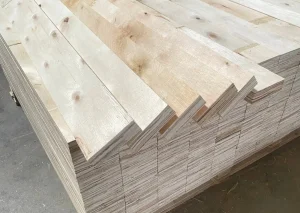
Cross-Grain Orientation: Adjacent layers are rotated 90 degrees to maximize dimensional stability and strength. Premium production at Plywood ThanhdoLLC utilizes full-stitched construction, where veneer strips are sewn together to eliminate gaps, ensuring superior screw-holding strength and flatness.
Stage 7: Pressing
-
Cold Pre-Press: Panels are compressed at room temperature (3–5 kg/cm²) for 10–20 minutes to achieve contact and begin tack-bonding.
-
Hot Pressing: Panels are cured under high heat and pressure (8–12 kg/cm²). Accurate temperature and timing—tailored strictly to the resin chemistry—are vital to ensure complete polymerization of the glue lines.
Stage 8: Trimming and Sanding
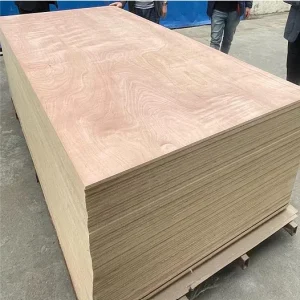
Panels are trimmed to exact dimensions (e.g., 1220 x 2440mm) to remove edge defects. Calibration sanders then use abrasive belts to ensure thickness tolerances of ±0.3mm (standard) or ±0.2mm (premium furniture grade).
Stage 9: Quality Control
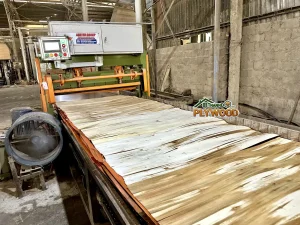
Plywood ThanhdoLLC employs a 5-stage QC system:
-
Veneer Sorting: Grading based on appearance and structural integrity.
-
Moisture Verification: Using precision meters post-drying.
-
Bond Integrity: Batch-level boiling water tests.
-
Dimensional Checks: Caliper measurements for thickness accuracy.
-
Final Inspection: Surface and edge checks before packing.
Stage 10: Packing and Loading
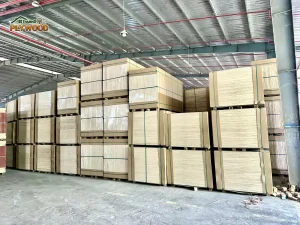
Pallets are wrapped in moisture-resistant film and steel-strapped. All packaging complies with ISPM-15 phytosanitary standards. Loading plans are meticulously calculated based on core density—ranging from 15 to 18 pallets per 40HC container—to maximize payload efficiency while staying within 28.5 MT limits.
Understanding Factory Segments
The same 10-stage process is executed differently depending on the facility’s segment:
-
Segment A (Furniture): Focuses on full-stitched eucalyptus/styrax cores and E0 emission standards.
-
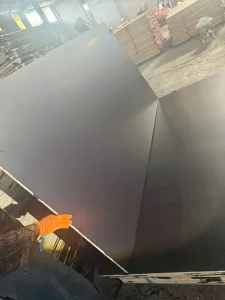
Segment C (Film-Faced): Utilizes WBP phenolic resin and premium AICA film for 15+ reuse cycles.
-
Segment B/D (Commercial): Prioritizes throughput and cost-competitiveness for non-structural or temporary applications.
By maintaining specialized facilities for each segment, Plywood ThanhdoLLC ensures that process parameters remain optimized for the specific resin chemistry and performance requirements of every order.